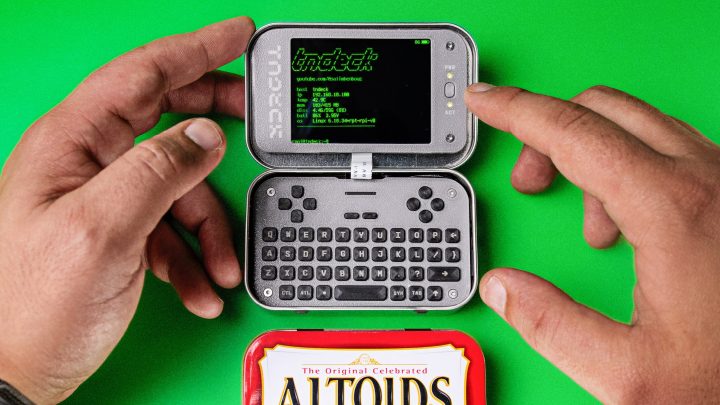
The Computer That Fits In A Mint Tin
Salim Benbouziyane crammed a working computer into an Altoids tin, keyboard included. Comfortable? He says no, the keys barely travel. I'll take a cramped keyboard I can carry in a…


Topic
59 formulae on file
Salim Benbouziyane crammed a working computer into an Altoids tin, keyboard included. Comfortable? He says no, the keys barely travel. I'll take a cramped keyboard I can carry in a…
Now that's a theme name with some swagger to it. Clockwork Alchemy runs Rogue Makers and Air Pirates for three days in Redwood City, October 16 to 18, and I'd…
On 23 September 1999, a NASA orbiter arrived at Mars after nine months and 400 million miles. Nothing aboard it was broken. Everything worked. It fired its engine on schedule, behaved impeccably — and passed behind the planet forty-nine seconds early.
Between 1985 and 1987, a machine built to treat cancer delivered massive radiation overdoses to six patients across North America. Three of them died.
In the summer of 1978, the engineer who designed a brand-new Manhattan skyscraper sat down to do a piece of arithmetic nobody had asked him to do. The building was finished. It was occupied. And the answer said it could be brought down by a storm New York could expect roughly every sixteen years.
In 1990 NASA launched the finest telescope ever built, and it came back blurred. Its mirror had been polished more precisely than any large mirror in history — to the wrong shape, too flat at the edge by about two microns, one-fiftieth the width of a human hair.
On 1 August 2012, two hundred and twelve ordinary customer orders arrived at Knight Capital. Forty-five minutes later the firm had made four million trades and lost roughly ten million dollars a minute.
In the autumn of 1994, a mathematics professor in Lynchburg, Virginia spent four months convinced he had made a mistake. He had checked his equations. He had rewritten his program. He had even found a genuine bug in his compiler — and it turned out to be innocent.
On 4 June 1996, Europe's brand-new Ariane 5 rocket lifted off from Kourou carrying four scientific satellites and ten years of work. Thirty seconds later it tore itself apart over a mangrove swamp.
On August 14, 2003, fifty million people from Detroit to New York City lost power in the largest blackout in North American history. There was no bomb. No attack. No mastermind. Just a hot afternoon, a few untrimmed trees, and a control-room alarm that quietly stopped ringing — and never told anyone it had.