

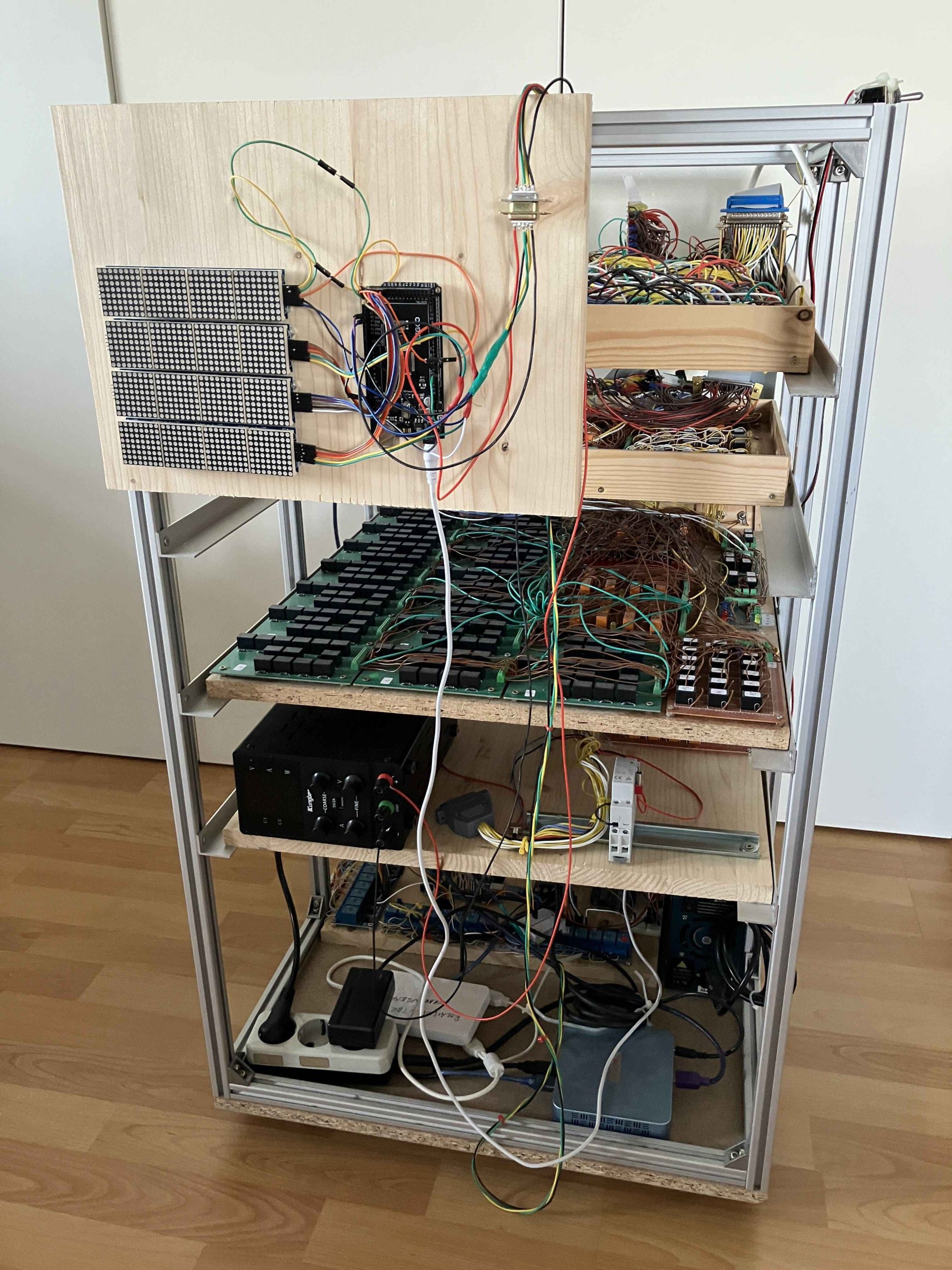
What does a 16-bit CPU look like when every bit is a relay? Like a bookshelf that clicks, and I love it.
The photo tells me the one thing I wanted to know: rows of black relays on green boards, a shelf of them, doing the actual work. Here’s how Peter describes the rest:
At the very bottom, we find the memory implemented using an Arduino
the clock generator, which is also built with a separate Arduino
Part of the system memory is now used as video memory, so the display is effectively memory-mapped.
Memory on a microcontroller is cheating, a little, but the relays are still the CPU and the Arduinos are the furniture. I can live with that, since a tape reader would be a lot worse to build. Everything goes through one accumulator, and the instruction set is 19 commands, per Hackaday.
Does it work? It does pi in about eight minutes, and the logs say 1,377 instructions got it to two decimal places. Do that math: a few instructions a second, at best, for a machine with shelves. The author’s own estimate for a Mandelbrot run in BASIC is 25 days on the real hardware, or 2 days if you write machine code. I’d take the 2 days, and I’d want to know the power draw for those 2 days, because the page lists the component list as one 24V relay and one diode, which can’t be the whole parts list. The relay count isn’t printed anywhere I could find, either, and with that many black cubes on the shelf I’m annoyed.
The circuit diagram and timing PDFs are on the project page, along with an online simulator and a BASIC compiler.